
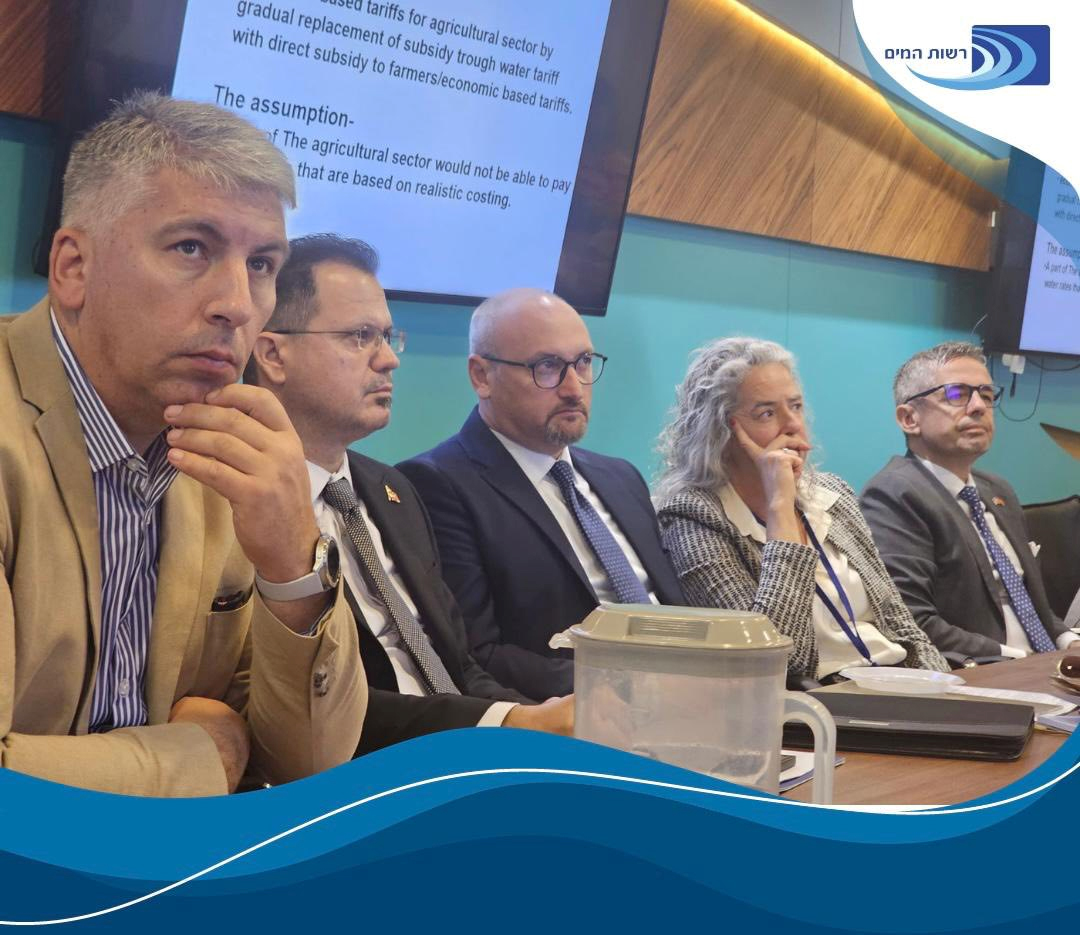
From 22 to 28 November 2025, CED FLOROZON’s representative, Mr. Kiril Ristovski, as a member of North Macedonia's national delegation of water experts, participated in a comprehensive study visit to Israel organized by the Ministry of Foreign Affairs of Israel. The visit aimed at strengthening knowledge, institutional capacity, and professional exchange in the field of integrated water resources management. The programme combined high-level institutional meetings, technical site visits, academic exchange, and civil society engagement, providing participants with a holistic overview of Israel’s water governance model and practical solutions for water scarcity, pollution control, and climate resilience.
The programme began with the arrival of the delegation in Jerusalem, followed by an introductory cultural visit to the Old City. This initial segment provided contextual understanding of the historical and social dimensions of water in the region, alongside opportunities for informal networking and group orientation.
A central highlight of the visit was the meeting with the Israel Water Authority, where participants received an in-depth overview of the Israeli water economy, regulatory framework, and water law. The opening address by the Chairman of the Water Authority focused on long-term planning, centralized coordination, and the integration of policy, infrastructure, and innovation. This session provided valuable insights into how strong institutional governance and clear legal frameworks underpin Israel’s water management success. The visit to Gihon Corporation, responsible for water and wastewater services in Jerusalem, further illustrated the operational dimension of urban water supply, efficiency, and service provision.
The programme continued with field-based learning at Kibbutz Kalia, where participants explored advanced irrigation systems, desalination practices, and the interlinkages between water management and agriculture in arid conditions. Discussions emphasized water efficiency, reuse, and the role of technology in sustaining agricultural production. Engagement with the Dead Sea Revival Association added a civil society perspective, highlighting environmental advocacy, public awareness, and ecosystem rehabilitation efforts related to one of Israel’s most sensitive water bodies.
Technical innovation was a key focus during visits to major infrastructure facilities. At the Sorek A Desalination Plant, participants examined large-scale seawater desalination processes, operational standards, and environmental safeguards. This was complemented by a visit to the Netafim Visitors Center, where drip irrigation technologies were presented as a globally scalable solution for water-efficient agriculture. The visit to Kibbutz Nir Oz provided further insights into community-level resilience and water use in challenging environmental and security contexts.
Academic and research collaboration featured prominently during the visit to Kinneret College, where participants engaged with the Water Engineering Department and its innovation center. Presentations highlighted the integration of academic research, applied engineering, and technological development, underscoring the importance of higher education institutions in driving innovation and training future water professionals. The subsequent visit to the Eshkol National Water Carrier Visitors Center offered a strategic overview of Israel’s national water conveyance system and its role in balancing regional water availability.
The final day of technical visits focused on national water companies and innovation ecosystems. At the Mekorot Visitors Center, participants gained insights into national-scale water supply management, infrastructure resilience, and digital monitoring systems. The visit to Shafdan, Israel’s central wastewater treatment and reuse facility, demonstrated advanced wastewater treatment, reuse for agriculture, and circular water management practices. The programme concluded with a visit to Start-Up Nation Central, where participants were introduced to Israel’s water-tech innovation ecosystem, start-ups, and public–private partnerships driving technological solutions in the water sector.
Throughout the study visit, discussions consistently emphasized key cross-cutting themes: integrated water governance, institutional coordination, data-driven decision-making, water reuse and desalination, climate adaptation, and the role of innovation and public participation. The visit provided participants with concrete examples and transferable practices relevant to the Western Balkan context, particularly in relation to river basin management, infrastructure modernization, and strengthening cooperation between institutions, academia, civil society, and the private sector.
The study visit concluded with the delegation's departure on 28 November 2025, marking the successful completion of an intensive and highly valuable professional exchange program.